Internal Designations:
TEACHING STEEPS

-
Teaching Steeps is the WB Snow School internal designation for teaching Level 6+ groups. It is part of the Ongoing (Paid) Training that we offer at the Snow School.
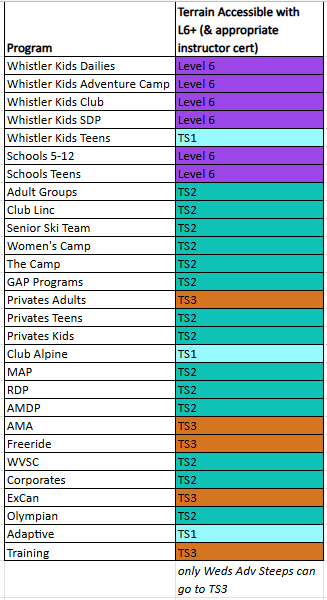
In addition to an instructor holding their Teaching Steeps certification AND the student being Level 6+, only certain programs can go to Teaching Steeps 1, 2 or 3 terrain.
Upon being signed off, each staff member will have an “internal designation” attached to their ProConnect profile and needs to obtain their TS1, TS2 or TS3 sticker from their trainer or supervisor. Wearing this on your name tag is part of your uniform if you wish to teach in “Steeps” terrain.
-
Teaching Steeps has been in place since around 2019 and has evolved over the last few years, with Teaching Steeps 3 being brand new for the 2025-26 season. At WB we have access to such a huge amount of terrain that goes beyond the scope of the traditional CSIA and CASI courses so we developed this designation to help support “how to teach in steep terrain”. This includes tactical as well as technical aspects that should be considered, assessed and developed in our students before increasing the level of difficulty in terrain.
Each Teaching Steeps level is designed to build on the one before in addition to in-field experience gained through teaching in appropriate programs and attending elective “Steeps” sessions.
-
In addition to the students being Level 6+, only certain programs can go to Teaching Steeps 1, 2 or 3 terrain. If you are working in one of those programs you need your Teaching Steeps. If you hope to work in one of those programs, speak to your supervisor and your “Steeps” trainers about opportunities.
Don’t forget to turn up on your fatter skis! Read why here.
-
Teaching Steeps is done by supervisor sign up only. Your supervisor puts forward the names of their instructors who need (or would like) to do their internal certification and the Training Supervisors fill the groups based on various factors. Please ensure you have gone to at least 1 elective “Steeps” session before asking your supervisor to put your name forward for a Teaching Steeps session.
-
From the New Year onwards, Teaching Steeps is regularly held on Thursdays, however we do run sessions on other days (including some weekends) based on participant schedules and trainer availabilities.
-
For new and experienced instructors who are teaching Levels 4-6 we are going to offer some “Big Mountain Basics” sessions.
These will cover a lot of the same tactics and techniques that are used in Steeps terrain as you develop your students through the SS benchmarks and challenging students with appropriate terrain for their level.
-
The width of ski is important for more than just pow days, it acts as a safety tool in steep terrain regardless of snow conditions.
Read more about why we ask you to be on skis wider than 90mm for Teaching Steeps and elective Steeps trainings.
-
Learn more about the TS3 process here
Big Mountain Basics
For new and experienced instructors who are teaching Levels 4-6. Supervisor sign up only.
These will cover a lot of the same tactics and techniques that are used in Steeps terrain as you develop your students through the Snow School benchmarks and challenging students with appropriate terrain for their level.
Elective Sessions to help you prep for this: ANY! Special mention to: Terrain, Tactics & Technique (Sundays), Bumps (Mondays), Intro to Steeps (Fridays).
WK Dailies
WK Adventure Camp
WK Club
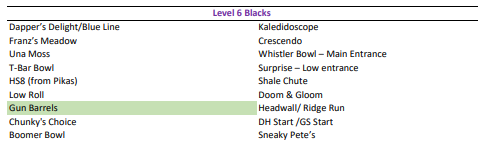
Programs who’s MAX terrain access is L6 terrain:
WK SDP
Schools 5-12
Schools Teens
Teaching Steeps 1
Teaching Steeps 1 is an Internal Designation that may be signed off in an internal paid training session. This designation allows instructors to teach higher level students in a specific terrain package that includes some double black terrain as per the snow school run list progression.
Instructors that hold the PSIC Big Mountain Level 2 do not have to take this internal designation as long as the course was taken at Whistler Blackcomb.
When either the Teaching Steeps 1 Internal Designation, or the PSIC Big Mountain 2 is passed, it will be noted on the instructor’s teaching profile in proconnect.
To attend a Teaching Steeps 1 Clinic, you must be teaching in a program that is allowed to access TS1 Terrain, are familiar and comfortable in this terrain and be put forward by your supervisor to attend this course.
The Intro to Steeps Elective sessions held on Fridays is a great way to prepare for this clinic or the Big Mountain 2 course.
Please read the Level 1 Course Guide below to understand the expectations of this day.
Before you attend:
Pre Quiz completed: Teaching Steeps Pre Course Quiz 2025.26 – Fill out form
Video watched - It covers in detail the decision making process , class management principles and the skiing standard
Familiarization with the SS Trail Map and programs which can access TS1 terrain.
Username: wbsnowschool Password: SkiSchool25
Teaching Steeps Level 1 Theory Video presentation. (Be aware that this video is from pre 25.26 so some information is out dated. New video to come soon.
Teaching Steeps Level 1 Course Guide
WK Teens
RH Club Alpine
Adaptive
Programs who’s MAX terrain access is TS1:
Teaching Steeps 2
Teaching Steeps 2 is an Internal Designation that may be signed off in an internal paid training session. This designation allows instructors to teach higher level students in a specific terrain package (TS2) that includes double black terrain as per the snow school run list progression.
Instructors that hold the PSIC Big Mountain Level 3 do not have to take this internal designation as long as the course was taken at Whistler Blackcomb.
When either the Teaching Steeps 2 Internal Designation, or the PSIC Big Mountain 3 is passed, it will be noted on the instructor’s teaching profile in proconnect.
To attend a Teaching Steeps 2 Clinic, you must be teaching in a program that is allowed to access TS2 Terrain, are familiar and comfortable in this terrain and be put forward by your supervisor to attend this course.
The Advanced Steeps Elective sessions held on Wednesdays are a great way to prepare for this clinic or Big Mountain 3 Certification.
Please read the TS 2 Course Guide below to understand the expectations of this day.
Before you attend:
Pre Quiz completed: Teaching Steeps Pre Course Quiz 2025.26 – Fill out form
Video watched - It covers in detail the decision making process , class management principles and the skiing standard
Familiarization with the SS Trail Map and programs which can access TS2 terrain
Username: wbsnowschool
Password: SkiSchool25
Programs who’s MAX terrain access is TS2:
Adult Groups
Club Linc
Senior Ski Team
Women’s Camp
The Camp
GAP Programs
Privates Teens
Privates Kids
Corporates
Olympian
RH MAP
RH RDP
RH AMDP
WVSC

Teaching Steeps 3
The Teaching Steeps 3 Internal Designation is required for pros to access TS3 Terrain.
This is a new level of Teaching Steeps and a new terrain package has been created. The process to obtain this designation is explained below.
Anyone holding the PSIC Big Mountain 4 certification will still need to be approved by the General Manager team.
Find out more about the TS3 process below.
Privates Adults
RH AMA
RH Freeride
Programs which can access TS3 terrain:
Extremely Canadian
Training (Weds Adv Steeps only)
Teaching Steeps 3 – the process explained
-
The Teaching Steeps 3 internal designation is the next level up from the Teaching Steeps 2. It holds equivalency with the PSIC Big Mountain Level 4. Having the TS3 allows pros in certain programs to access terrain within the resort that has the highest consequence.
-
We created the TS3 for a few reasons but primarily to keep you, our instructors, as safe as possible and to assist with decision making in the field.
Over the years, the Teaching Steeps program has developed from being Kids specific to being Snow School wide. In addition, a lot of the terrain has physically changed, and continues to change over with every season due to season-specific weather, coverage, snowpack and, unfortunately, melting glaciers. These led us to revamp the SS Trail Map and create this new designation.
-
We reached out to around 70 people including pros who regularly teach programs in Steeps terrain, supervisors and managers who have staff in this terrain, external experts and patrol, and gathered their views on the content of the existing Teaching Steeps 1 & 2 designations as well as all the double and triple black terrain. Runs were rated in terms of the risk of consequence, from Low/No Consequence if you fall, to Fatal (which have become No Go Zones for Snow School). Remember, sometimes, it’s access to the actual run, or simply the entrance that makes something more consequential.
Collectively, we came up with new terrain packages for Level 6+. Somethings have moved down from TS1 to Level 6, and some things have moved up to TS1 or TS2 and ended up in the new TS3 terrain package or become No Go terrain.
In addition, we had input in collaborating the ‘consequences’ information you can find on every double and triple black run on the new SS Trail Map. This extra info, designed to help educate those that don’t know the terrain so well, outlines the “permanent consequences” (what’s always there every season regardless of conditions), “potential condition variations/problems” (how does this run change year to year or within a season) and “other pertinent considerations” (what else is useful to know about this run). We hope that you find this helpful and assists you with getting to know the mountain and your decision-making!
-
Primarily, the instructors that need their TS3 are those that currently work in that terrain; they work in pods that regularly require taking groups into TS3 terrain. Currently this is only 4 programs: Freeride, AMA and Extremely Canadian, Adult Privates. As we roll out this program, things may change. As people aim to move pods within the Snow School, we know more people will need their TS3 to do their job. For now, we’re starting with select pros from these programs that supervisors have put forward to get their TS3 designation.
-
To obtain your TS3, the following steps will be taken:
Supervisors/Managers will put names forward of anyone working for them that will potentially be teaching in TS3 terrain.
On a periodic basis, the training team will sit with a ‘Council of Peers’ to review the names put forward and endorse or express any concerns regarding the following criteria:
Demonstration of good decision making
Technical skill in high consequence terrain
Class management practices demonstrated by instructor
Demonstration of Terrain Knowledge, Comfort and Experience in TS3 terrain
Those whose names have obtained a quorum of endorsements from the ‘Council of Peers’ are then put forward to the General Managers. General Managers will have final approval of pros that will have TS3 status added to their proconnect profile. Factors that will be considered at this level:
Safety Record of the pro and guests in their care
Demonstration of consistent good decision making
100% Reliability based on past performance that the pro leads by example and puts their safety and the safety of their guests first.
For pros that have been put forward but not endorsed by council, the training team will follow up with the relevant supervisor/manager to create a development plan for that pro to advance in the process.
If signed off, pros should collect their TS3 sticker(s) for name tag(s) from their supervisor. Like a Park Safety Sticker, the Teaching Steeps stickers need to be worn so that supervisors and mountain workers know at a glance if pros should be accessing TS3 terrain.
Pros with the TS3 Designation or PSIC Big Mountain 4 Certification will have it noted on their ProConnect profile
Big Mountain Glossary
AKA Freeride, Off Piste, Steeps, Alpine…
This world has it’s own whole set of terms and specific language. If you want to decipher some of these, check out our Big Mountain Glossary.
Are we missing some? Let us know!
Aspect
The compass direction a slope faces. Crucial in decision making as it affects how much sun and wind exposure a slope receives. The snow quality and avalanche conditions are directly affected by the aspect of the slope.
Bomb-Hole
A packed-out hole in a powder landing usually caused by another skier’s landing or crash.
Chalky
Dry, easily edgeable snow that often forms off-piste when it’s consistently cold and windy. This can be excellent for skiing the Big Mountain even when the snow is skied out.
Chute
A narrow, steep strip of snow flanked by rock walls, often challenging due to its constricted space and steepness.
Cirque
A bowl-shaped, steep-walled mountain basin, often formed by the erosion of glaciers.
Cliff Band
A natural shelf of terrain which results in a set of cliffs. This might have airs to hit or present a serious exposure risk which needs to be navigated around.
Cliff-Out
Some routes “cliff out,” meaning there's no safe exit. Know your line before committing.
Close-Out
A line that ends with a mandatory air. There is no option to ski around the feature once the skier is committed.
Compression
A part of a line in which speed and a change in angle (or hole) can cause a build up of forces to the skier. This can present a hazard if the skier is unbalanced.
Cornice
An overhanging edge of snow on a ridge or peak, often created by wind. It can create a challenging entrance or a hazard due to potential collapse. Cornices can change significantly in a short span of time.
Couloir
A narrow gully with steep walls. French for ‘hallway’.
Debris
Hard pieces of snow from collapsed cornices. Can present danger when combined with higher speed and lower visibility.
Drop
A piece of terrain where the skier leaves the ground travelling from higher to lower. Often over rocks or natural terrain feature.
Exposure
The possibility that a fall (even at slow speed) could take the skier over terrain (rocks or cliffs) that could injure or kill them.
Fall Line
The direction that a ball would roll down a hill due to gravity. The quickest path down a mountain. Understanding the fall line is crucial for controlling speed, navigating terrain and making turns.
Hit (Side Hit)
A jump, natural or man made. A side-hit refers to jumps which form on the side of runs.
Lip
A natural take-off point at the top of a ramp.
No-Fall Zone
A piece of terrain in which a fall could cause serious injury or death if the skier does not manage to self-arrest.
Nose
The highest or most obvious take-off point of an air or cliff.
Pillows
Stacks of powder that form on top of boulders and under-snow formations. Are often varying levels of firm.
Rock-Well
A hazard created by the wind blowing round a boulder that creates a hole on the lee-side of the rock.
Self-Arrest
The ability of the skier to stop the momentum of their fall either with skis or without. They might use the edges of their skis to dig into the snow or stop themselves with their hands and feet. The ability to self-arrest is crucial when skiing in steep terrain or near any kind of exposure and is a skill which can be trained and practiced.
Skiied Out
A term referring to an area in which the higher quality or fresh snow has been mostly skied, leaving less desirable conditions
Sluff
Loose surface snow that moves on top of the snowpack. Often this is human-triggered and is more likely when skiing steep slopes.
Spine
Snow that forms on top of ridges and steep pieces of terrain in a natural ‘spine’ formation. Common on the huge faces of Alaska.
Straight-Line
A terrain feature which is too narrow to turn the skis sideways to manage speed. It necessitates going straight in the fall-line and managing speed using terrain or turns later.
Tabletop
A jump with a flat section on top and a down-slope afterwards.
Transition
The point at which the terrain changes angle from steep (or vertical) to flatter. A safe jump will have a steeper landing with a smoother transition.
Tree Well
A depression around the base of a pine tree caused by the sheltering effect of the pine branches. The snow tends to be less consolidated than the surrounding snow and can present a dangerous hazard if the skier becomes immersed in it.
Wind Loaded/Loading
The process where wind transports snow from windward slopes and deposits it on the lee (downwind) sides of terrain features, forming wind slabs. These wind slabs can become unstable, leading to avalanche hazards.